Sulphur is usually present in seawater in the form of sulphate. With more than 2,500 mg/l (0,26 US.liq.gal.) sulphate, it belongs to the macro elements. The sulphur input into the aquarium is constantly high and only little is consumed. Sources are sea salts, feed, but also cheap trace elements concentrates and amino acid solutions may contain larger amounts of sulphates.
1
/
of
3
BOS Reef
Fauna Marin ELEMENTALS TRACE S - 1000ml
Fauna Marin ELEMENTALS TRACE S - 1000ml
Regular price
$28.86 USD
Regular price
Sale price
$28.86 USD
Shipping calculated at checkout.
Quantity
Couldn't load pickup availability
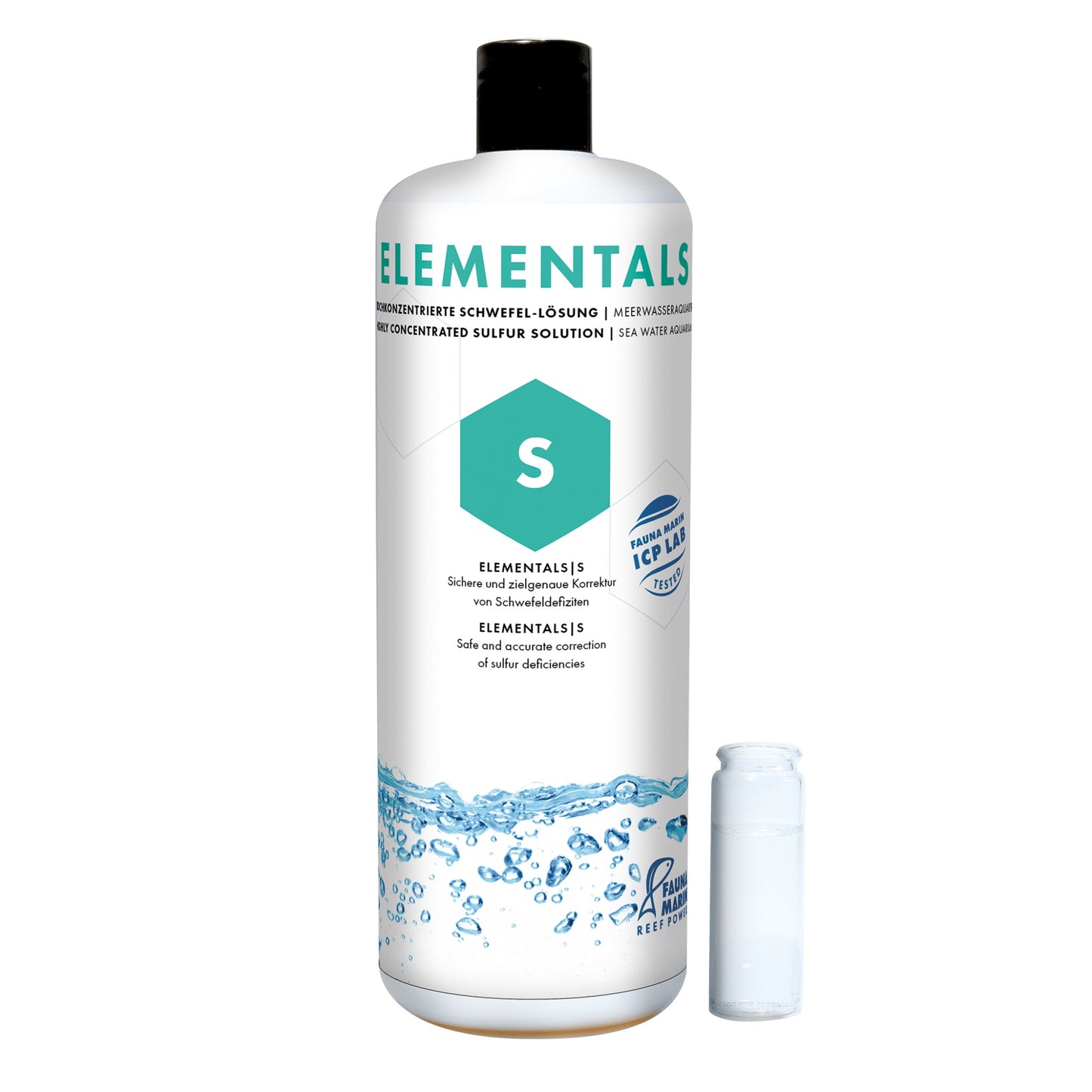
ELEMENTALS S for a safe and accurate correction of sulfur deficiencies.
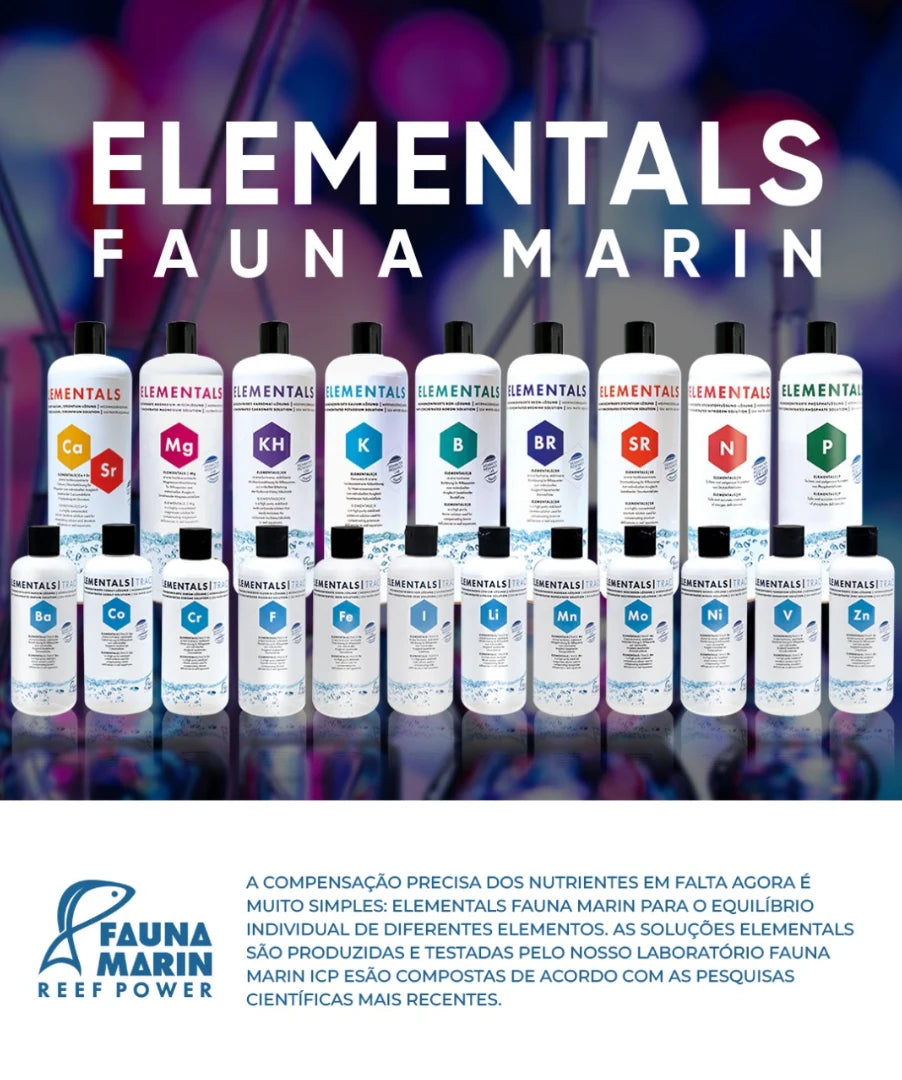
The Elementals series is designed for use with regular ICP analyses. Fauna Marin ICP analyses help you to perfectly supply your aquarium.
Fauna Marin ICP analyses provide you with all necessary dosage recommendations in addition to the measured values. In addition to the salts of the bulk elements calcium, magnesium and carbonate hardness, we also offer a range of special elements whose function is essential in the marine aquarium. These elements are in contrast to trace elements such as copper, chromium, manganese or selenium, but also iron, iodine or zinc, elements which are present in seawater in greater concentrations than 1 mg/l. These include, for example, potassium, strontium, boron, bromine and fluorine.
The function of these elements can be very different. See the knowledge base on the Fauna Marin website for an overview of each element’s function. Quantitative elements can be present in many different substances and thus also enter the aquarium water; however, their deficiency can cause significant problems in the aquarium. An adequate supply of all important elements is therefore indispensable for a healthy reef aquarium.
Fauna Marin's single element solutions consist of the purest raw materials, which are produced with the appropriate organic or inorganic compounds, depending on the function of the elements.
Fauna Marin ELEMENTALS How-to-Use
Additional Info:
What is it?
Sulphur occurs in seawater as sulphate and is part of normal seawater. A few amino acids and other compounds also contain certain amounts of sulphur, but these are negligible. Sulphate in itself is not dangerous, but reduced forms that can occur in oxygen-free areas of the aquarium are very toxic and often cause problems. Sulphur bacteria can also cause an accumulation of sulphur in the bottom gravel. These should generally not be dosed into a saltwater aquarium.
Problems:
High or too low sulphate levels should be avoided. Differences can easily be compensated by means of some partial water changes. For shifts of more than 30 %, please contact our laboratory for verification of the data. Too low sulphate values can be a trigger for bacterial infections (RTN/STN) on corals
Measures:
Regular control of the sulphur and/or sulphate value, regular partial water change with Professional Sea Salt. Avoid mineral salts or single doses of sulphate-rich trace mixtures.
Indicator species:
Too high or too low values are extremely rare, so there are no special animals or algae that could serve as an indicator. If bacterial diseases on corals appear in the aquarium, it makes sense to check the sulphate value.
Sulphur itself is found as a decomposition product of special bacteria or components of amino acids in water and especially in the substrate. There it is oxidized to sulfate by specialized bacteria, but is then converted to hydrogen sulfide in anoxic areas of the aquarium. This creates rotten spots in the tank. During this process, sulphides are constantly released into the water, preventing the cells from breathing. Rotting spots in the tank are therefore to be avoided at all costs.
Sulphate itself is important for the corals for the defence against pathogenic germs. We have not yet been able to determine a limit value in experiments, so we recommend that natural concentrations be maintained. A fluctuation of 10 % is harmless.
The relation of both values to each other (sulphur and sulphate) can give an indication of disturbances in the sulphur cycle.
During the decomposition of organic substances (including undigested fish food), sulphur compounds are split off as hydrogen sulphide. The oxygen immediately oxidizes this to sulfate. Conversely, sulphate in sediments is reduced to hydrogen sulphide by sulphate reducing bacteria. This happens relatively quickly in the aquarium, especially in areas with poor water flow, under detritus accumulations and at low nitrate levels. This should absolutely be avoided. Avoid the dosing of sulphur bacteria, these support the buildup of PO4 deposits in the substrate.
Tip:
The Balling light system is composed of minerals in such a way that there is no accumulation of sulphates in the system. The other entries together with feed, salt mixtures and trace element concentrates are usually more than sufficient for this purpose. Some salt mixtures contain more or less sulphates than the reference value. However, this generally does not give any particular advantages. Therefore, use salt mixes whose sulphate value is based on natural values.
Share