Bromine is an often underestimated element, but for corals it is extremely important. Stony corals use bromine for the synthesis of colouring chromoproteins, and they need it to form their skeletal structure. Zooxanthellae use it for the production of enzymes that are irreplaceable in photosynthesis. Some soft corals, such as Dendronephthya, accumulate bromine in their tissues and use it as a raw material for toxin production so that plankton can be caught. Gorgonians and algae also accumulate bromine in their tissues. The consumption is rather low even in heavily populated tanks. Our measurements showed that a daily replenishment of approx. 0.7–1.2 mg bromine/100 l (26 US.liq.gal.) can keep the value stable. A lower bromine value is not much harmful for most corals, but the fluorescence and the glow of the corals are quickly lost.
BOS Reef
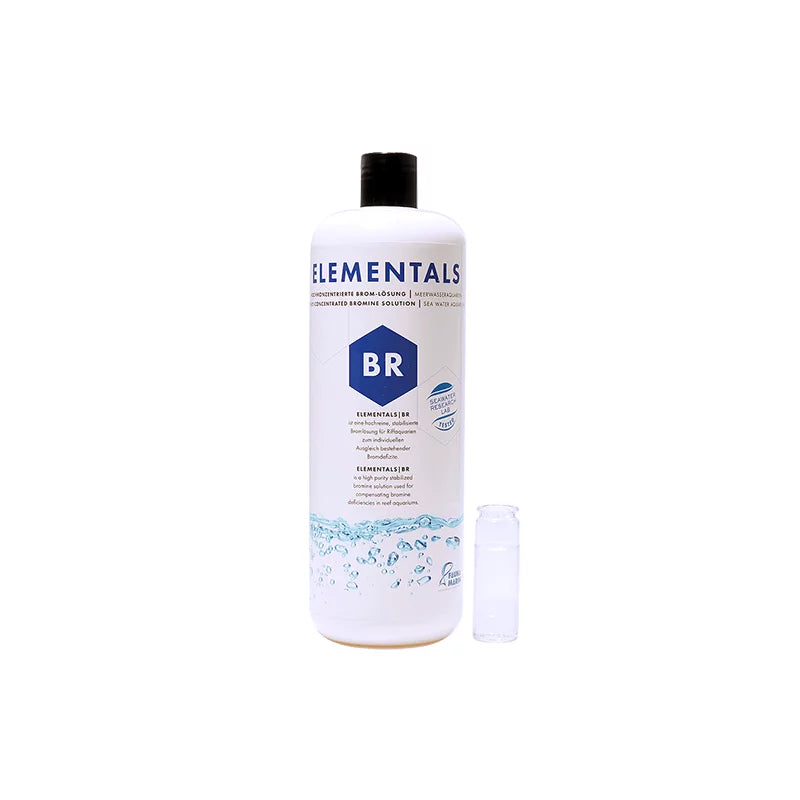
Fauna Marin ELEMENTALS BR - 1000ml
Fauna Marin ELEMENTALS BR - 1000ml
Couldn't load pickup availability
ELEMENTALS BR is a high purity bromine solution used for compensating bromine deficiencies in reef aquariums.
The Elementals series is designed for use with regular ICP analyses. The Fauna Marin ICP analyses help you to keep your aquarium perfectly supplied.
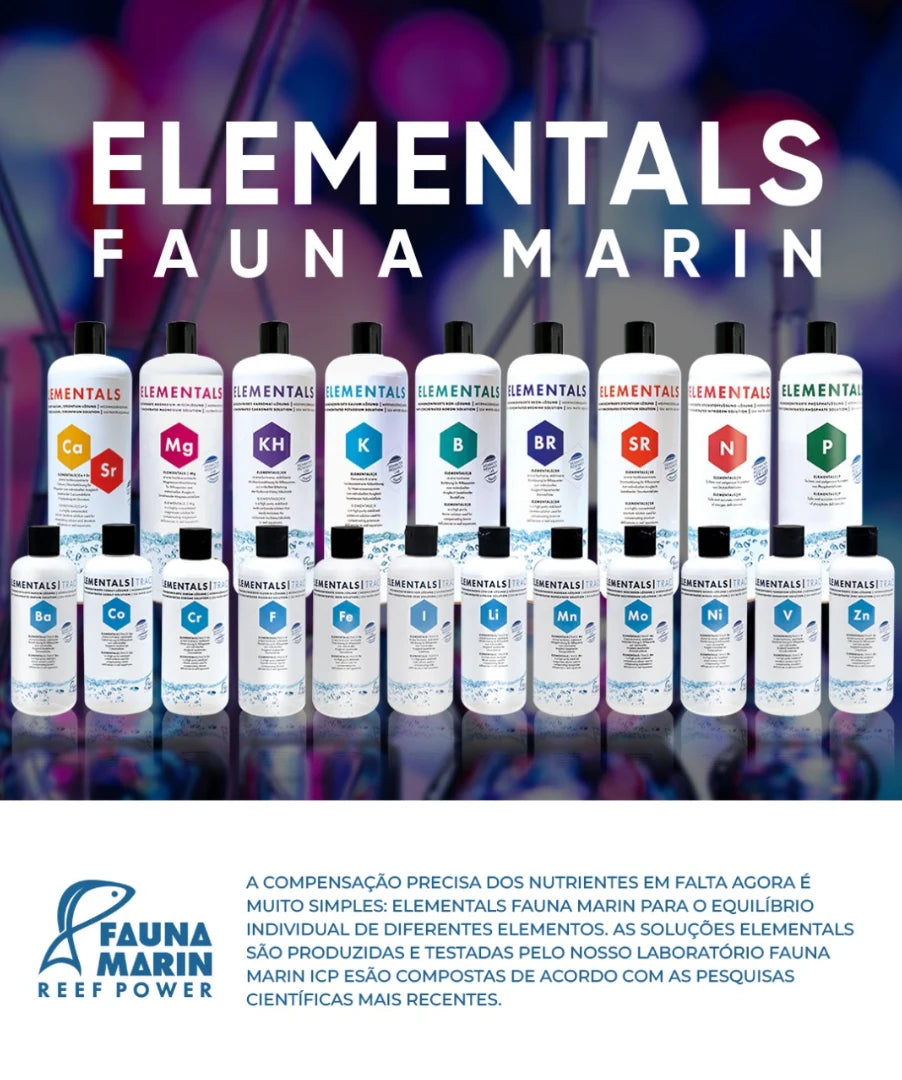
In addition to the measured values, Fauna Marin ICP analyses provide you with all necessary dosage recommendations. In addition to the salts of the macro elements calcium, magnesium and carbonate hardness, we also offer a number of elements whose function is essential in saltwater aquaria.
In contrast to trace elements such as iron, zinc or vanadium, macro elements are present in seawater in concentrations of more than 1 mg/l. These include, for example bromine, boron, potassium or strontium.
The function of these elements can be very different. In the knowledge database on the Fauna Marin website you will find an overview of the respective function of the individual elements. Macro elements can be contained in many different substances and can therefore also enter the aquarium water. However, despite their necessary concentration in the water, their deficiency can cause considerable problems. An adequate supply of all important elements is therefore indispensable for a healthy reef aquarium.
Fauna Marin's single element solutions consist of purest raw materials, which are produced with the appropriate organic or inorganic compounds depending on the function of the elements.
Fauna Marin ELEMENTALS How-to-Use
Additional Info:
What’s that:
Bromine belongs to the halogens and is an important macro element in seawater. Bromine is an essential element that has a direct effect on biological processes and the growth of corals as well as an inhibitory effect.
Problems:
Too little bromine leads to loss of colour and growth, especially in soft corals, gorgonians, sponges, but also hard corals. Bromine is also important for the formation of fluorescent effects. Too high values from approx. 90 mg/l (0,26 US.liq.gal.) cause tissue detachment, starting in the middle portion of the coral.
Measures:
Regularly control the bromine value, if necessary adjust the dosage, reduce it by partial water change and use of activated carbon
Indicator species:
A too low bromine value is reflected in pale colours, the loss of blue and purple fluorescence (indicator species Cespitularia soft corals and blue Xenia species as well as gorgonians). Aquaria with too low bromine concentration usually develop more severe damage when parasites appear.
Bromine has a brightening effect on the coral tissue and provides a porcelain-like coloration, even under very blue-dominated lighting. Below a value of 50 mg/l (0,26 US.liq.gal.) there is a weaker polyp expansion and the colours become blurred, especially with multicoloured hard corals. For a good color contrast, a bromine value of at least 65–70 mg/l (0,26 US.liq.gal.) is necessary.
But bromine is not only important for colour development. Gorgonians use a horn scleroprotein called gorgonin to stabilize the skelet. This protein contains high proportion of bromine, which, together with other halogens and amino acids, provides the skeletal substance. Some soft corals such as blue fluorescent Cespitularia lose their blue colour if the bromine levels are too low.
Share